






The Human Factor in Cybersecurity: The Weakest Link or the Strongest Asset?
The world of cybersecurity is becoming more complex with each passing day. Despite the emergence of new technologies and the hiring of the best experts, companies are increasingly feeling the threat of cyberattacks. So why is it so difficult to prevent cyberattacks despite all these technological investments? Everyone aware of the issue knows that the “human” factor lies at the heart of many vulnerabilities and attacks in cybersecurity. People are often regarded as the weakest link in the cybersecurity chain.
Human Error in Cybersecurity
In the context of cybersecurity, human error is defined as the unintentional actions or inactions of employees or individuals that lead to a security breach or disruption in the system. This definition covers a broad spectrum of scenarios, from executing a malicious email attachment or clicking on a suspicious link to forgetting to enable a security setting on a server or skipping the application of security patches. Human errors often occur as a result of neglecting best practices or making poor decisions.
Types of Human Error
Although there are countless ways in which people can make mistakes, these can generally be categorized as skill-based or decision-based errors.
Skill-based errors arise from a lack of technical expertise when performing a task or carelessness caused by automated behaviors. For instance, misconfiguring a firewall is a skill-based error.
Decision-based errors, on the other hand, typically occur when incorrect decisions are made in situations of uncertainty or lack of information. Falling for a phishing scam by clicking on a suspicious link or misinterpreting a security alert are examples of decision-based errors.
Common Examples of Human Error
Some frequently encountered situations involving human error include:
- Creating weak or reused passwords
- Falling victim to phishing or social engineering scams
- Sending sensitive information to the wrong recipients
- Skipping security updates or patches
- Misconfiguring security settings
- Mishandling sensitive data improperly
- Installing unauthorized software
- Neglecting to use multi-factor authentication (MFA)
- Ignoring security alerts
- Intentional or unintentional insider threats

Key Factors Leading to Human Errors
The main factors contributing to human errors are often divided into three categories: opportunity, environment, and lack of training.
- Opportunity: Humans are not flawless like computers. Over time, especially with routine tasks, they may become lax, leading to a lack of attention to detail. The more opportunities people have to make security-related decisions, the more likely they are to make mistakes.
- Environment: Physical conditions (e.g., lighting, noise, temperature), complex processes, high workload, tight deadlines, insufficient communication or resources, and the physical/mental health of employees all increase the likelihood of error. Unmotivated employees may also be less attentive.
- Lack of Training: When employees are unaware of risks or insufficiently trained in what to do, the likelihood of mistakes rises. Employees who cannot recognize phishing attacks are far more likely to fall victim to them. This is often not the employee’s fault; organizations need to provide periodic, role-based training. Moreover, a lack of awareness about cyber risks, along with cognitive factors like uncertainty or lack of information, increases the chance of errors.
These oversights and mistakes can cause serious harm to companies, including information theft, financial losses, and reputational damage, as well as secondary problems like reduced productivity, time management issues, and the loss of customers. The average cost of mitigating a cyberattack is high.
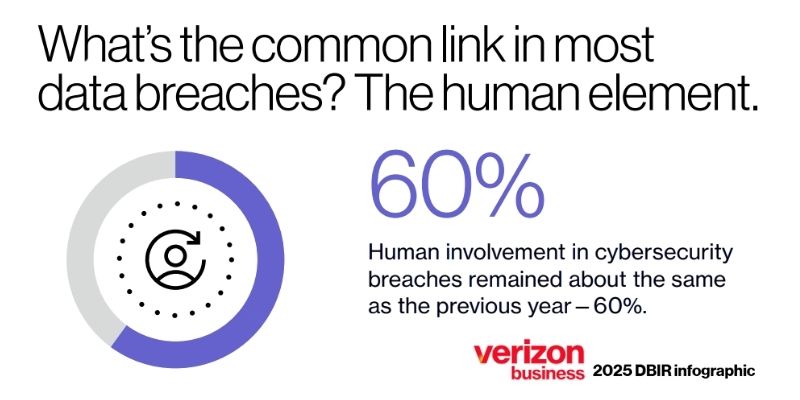
Human errors remain a critical factor in exposing organizational breaches. According to the 2025 DBIR data, approximately 60% of verified breaches are found to originate from human actions.
Solutions and Preventive Measures
What can be done?
- Strategies for Managing the Human Factor
While investing in technology is important, it is insufficient on its own. The most effective approach in cybersecurity combines technology with the education and awareness of individuals. Training is crucial to empower people.
- Training and Awareness Programs
It is essential to provide employees with regular, up-to-date, and effective training on cybersecurity threats. These training programs should not only be theoretical but also supported by practical applications and simulations. For example, phishing simulations can be used to test employees’ ability to recognize such attacks. The training should not be a one-time event but a continuous, ongoing process. Employee awareness of risks, transparency, and awareness are critical.
- Building a Strong Security Culture
Cybersecurity is not just a matter of technology but also a matter of culture. Embracing a security culture within the organization ensures that every individual acts more responsibly and attentively toward cybersecurity risks. It is crucial for management to adopt this culture and actively plan around it.
Viewing security as a value rather than just a task brings sustainable success.
- Technical Controls and Process Improvements
While technical solutions cannot eliminate human error entirely, they can minimize its impact. Measures such as role-based access controls, network segmentation, strong authentication (e.g., MFA usage), mandatory use of password managers, encryption, regular software updates, and secure configuration management should be implemented. Creating user-friendly security policies is also important. Clarifying roles and responsibilities, improving communication, and reducing workload pressures can help mitigate errors.
- An Approach to Empowering People
Although it is impossible to completely eliminate the human factor in cybersecurity, effective collaboration between people and machines is achievable. Automation can reduce human errors in routine tasks. The key is to create a cybersecurity ecosystem that strengthens and supports people rather than blaming them. Ongoing performance monitoring and risk assessment should also be part of this process.
Conclusion
In summary, the importance of the human factor in cybersecurity cannot be understated. While human error is inevitable, it is within our control to create systems, processes, and a culture that minimizes the impact of these errors. Instead of blaming people, establishing a cybersecurity ecosystem that supports and empowers them is the right step forward.
Cybersecurity is no longer just a technical issue but a socio-technical one, requiring attention to human behavior, organizational culture, and training.
With the right approach, continuous education, a strong security culture, and supportive technical controls, employees can become our strongest assets against cyber threats. Creating secure digital environments involves striking a balance between strengthening technological defenses and raising employee awareness.
If the human factor is neglected, it becomes the system’s vulnerability; if strengthened, it becomes the foundation of its defense.
Related Posts


Cyber Insurance
- May 27, 2025

How to Boost your Linkedin Profile?
- May 16, 2025