






In today’s age of technology, we have begun to spend a large part of our lives in virtual worlds. In this situation, not only individuals but also many institutions like governments, authorities, public institutions, companies, and small or large firms communicate through electronic media to provide their customers with the services they offer.
It is evident that wealth, privacy, and personal information in cyberspace need to be protected just as they are in real life.
Why Choose Cybersecurity as a Career?
It is evident that wealth, privacy, and personal information in cyberspace need to be protected just as they are in real life.
For this reason, cybersecurity has become one of the most critical topics of the modern age for businesses, organizations, and governments. Companies, governments, and organizations across all industries, whether large or small, face this threat as hackers become increasingly knowledgeable and exploit security vulnerabilities. Cyberattacks can cause companies to suffer both informational and financial losses.
Many people think that cybersecurity is only about antivirus programs or firewalls. However, cybersecurity is a vast field that requires billions of dollars of investment, depending on the needs and risk levels of companies.
The increasing number of e-commerce platforms and the growing integration of machine learning, the Internet of Things (IoT), and cloud computing are expected to drive market growth. Fortune Business Insights™ highlighted this in its report titled “Cyber Security Market, 2021-2028.” The cybersecurity market was valued at $153.16 billion in 2020 and is projected to reach $352.25 billion by 2026. According to a report by the European Cybersecurity Organization, the UK government spent nearly $2.3 billion in 2020 on internet and network security projects for defense and research. This increasing government investment in internet security solutions to protect their confidential data and information is expected to drive market growth. Furthermore, the introduction of new network security solutions by emerging and existing market players is likely to boost market growth. For instance, Palo Alto Networks Inc. launched Zero Trust Network Security in May 2021 to protect enterprises from cyber risks.
Nonetheless, the cybersecurity battles of 2021 will continue into 2022. With software accounting for the largest sector weighting in the S&P 500 and industries from automotive (Tesla) to healthcare (Teladoc) being affected, the threat landscape is becoming increasingly complex. Today’s global economy is increasingly dependent on how businesses, governments, and individuals protect themselves from cyber threats. Additionally, the rise of a decentralized and hybrid economy has made it easier for malicious attackers to cause harm, while cryptocurrencies have made it easier to enable untraceable ransom payments.
Cybersecurity Talent in the U.S.
According to CyberSeek, an initiative funded by the National Initiative for Cybersecurity Education (NICE), nearly 597,000 cybersecurity professionals were missing in the United States as of September 2021. Comparatively, the total number of workers employed in cybersecurity is slightly over 1 million.
The national average is 68%, meaning that the United States has only enough cybersecurity professionals to fill 68% of the cybersecurity jobs demanded by employers.
Microsoft recently launched a national campaign with U.S. colleges to bring 250,000 people into cybersecurity by 2025, addressing half of the workforce gap in the U.S. Google placed a full-page ad in The Wall Street Journal stating that it aims to train 100,000 Americans for critical privacy and security jobs. A Fact Sheet released by the White House announced that IBM would train 150,000 people in cybersecurity over the next three years.
Here are the top cybersecurity job titles and their average salaries, according to CyberSeek:
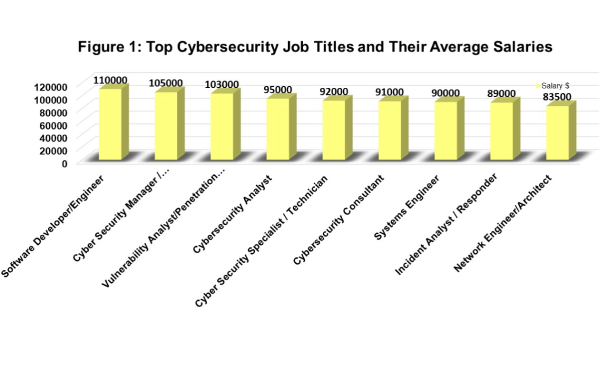
- Cybersecurity Analyst: $95,000
- Cybersecurity Consultant: $91,000
- Cybersecurity Manager/Administrator: $105,000
- Software Developer/Engineer: $110,000
- Systems Engineer: $90,000
- Network Engineer/Architect: $83,500
- Vulnerability Analyst/Penetration Tester: $103,000
- Cybersecurity Specialist/Technician: $92,000
- Incident Analyst/Responder: $89,000
Cybersecurity Talent in the UK
In the United Kingdom, pursuing further education in cybersecurity offers people the chance to build a rewarding career.
Currently, it is estimated that there are between 98,000 (low) and 171,000 (high) people employed in cybersecurity in the UK. For modeling purposes, the average figure has been assumed (i.e., 134,500 individuals).
Demand for cybersecurity experts has grown by an average of 14% annually since 2016. Over the past year, it has increased by 9%, indicating that the number of cybersecurity employees in the UK would need to increase by about 12,000 people annually to meet the demand.
The number of employees in cybersecurity decreases by approximately 4,000 to 7,000 annually (midpoint: 5,500). Overall, this means that the UK must hire at least 17,500 people each year to meet the new demand and replace lost workers.
Regarding inflow, it is estimated that about 7,500 new individuals start a career in cybersecurity each year in the UK. This indicates that the UK needs to recruit 17,500 new people annually for cybersecurity roles to meet the demand, but only produces 7,500 new recruits. This results in an annual deficit of 10,000 people (as of 2021), in addition to the currently observed talent shortage and the potential for further increased demand in the future.
Figure 2: Inflows, Recruitment Pool, and Outflows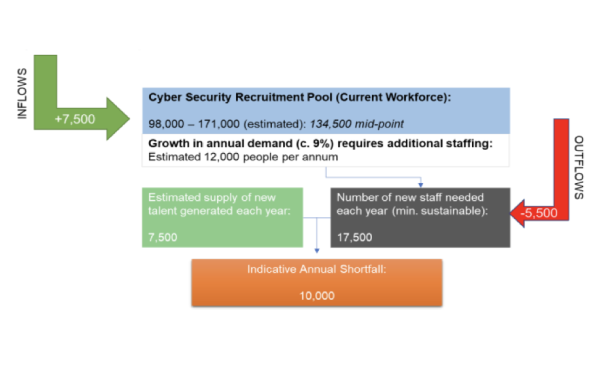
Cybersecurity Professionals in Germany
Germany is on its way to becoming a technologically independent country in terms of cybersecurity, much like the United States and China. In August 2020, the country announced a federal agency to address cyberattacks and strengthen the country’s digital security. The agency is to be supported with a total of $412 million by 2023 to develop further innovations and solutions to combat cyberattacks.
In response to the growing threats of advanced cyberattacks, the German government adopted the Cybersecurity Strategy for Germany 2021. The strategy includes four main guidelines:
- Establishing cybersecurity as a shared responsibility among the state, economy, society, and science.
- Strengthening the digital sovereignty of the state, economy, science, and society.
- Ensuring the secure development of digitization.
- Making objectives measurable and transparent.
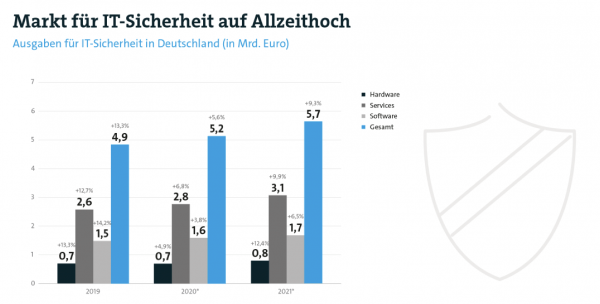
Not only has the German government made cybersecurity a key factor in its digital agenda, but businesses are also boosting their spending on cybersecurity solutions and are open to deals and investments in the cybersecurity field. As the following chart illustrates, spending on cybersecurity has steadily increased in recent years and is expected to continue to grow.
The global demand for cybersecurity professionals continues to rise rapidly. Over an eight-year period studied by Cybersecurity Ventures, the number of cybersecurity job openings increased by 350%, from 1 million positions in 2013 to 3.5 million in 2021. Career opportunities for Germans will be significant. By 2022, Europe is expected to face a shortfall of 350,000 cybersecurity professionals.
The estimated number of cybersecurity employees in Germany is currently 133,000. Cybersecurity will remain an integral part of every organization in Europe. The European cybersecurity market is expected to reach $22.67 billion by 2027, up from $8.56 billion in 2020, with a CAGR of 14.93% for the period 2020–2027. Europe places high importance on cybersecurity, funding equipment and infrastructure. As the demand for robust security grows in banking, financial services, insurance (BFSI), and defense, the market for cybersecurity and the range of solutions available are expected to grow.
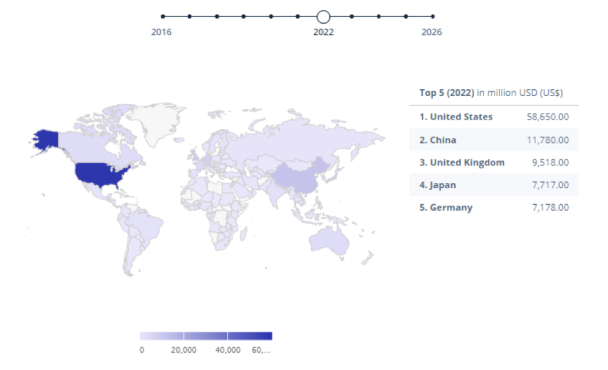
Cybersecurity is a topic with which virtually every company must engage. Driven by growing awareness of risks and threats, the market for cybersecurity solutions is expanding rapidly. Cybersecurity is increasingly becoming part of strategic planning at the highest level. The shift toward remote work and the increasing number of cyberattacks provide new momentum. The market is expected to continue to grow strongly, with a trend toward targeted investments. This is evident when comparing incomes in different countries.
Figure 3: Income Comparison
Summary
Cybersecurity needs you. Cybersecurity requires not only people with technical expertise but also individuals with diverse backgrounds, including business, law enforcement, military, academia, and marketing design. If you believe in yourself and your abilities, cybersecurity needs you.